
Why Do I Care So Much What Other People Think?
How to stop looking outside yourself for reassurance and start trusting your own judgement
Do you find yourself worrying about what other people think, comparing yourself to others or looking outside yourself for reassurance before you trust your own judgement?
It can happen so quickly that you barely notice you’re doing it.
Someone else succeeds and suddenly you’re questioning your own progress. Someone doesn’t agree with a decision you’ve made and, even though you felt quite sure about it before, now you’re wondering whether you got it wrong.
You read something unsettling in the news and the world feels a little less safe than it did ten minutes ago.
Or you post something you’ve worked hard on, it gets very little response and before you know it, you’re wondering whether it was any good in the first place.
And then there are those small changes in people that we can become incredibly good at picking up on. Someone seems a little quieter than usual, their message feels different, or they don’t respond in quite the way you expected, and your mind gets to work.
Did I do something? Are they upset with me? What does this mean?
Sound familiar?
What’s happening in all of these situations is that something outside of you has changed something within you. Your confidence, your mood or the way you were feeling about a decision can shift simply because of something you’ve seen, heard or noticed around you.
This is what I mean by reactive mode.
Rather than having a moment to work out what you’re actually feeling, what something really means and whether it even needs a response, you find yourself reacting to whatever has just happened around you.
And when this happens often enough, you can end up spending an enormous amount of time focused on everything outside of yourself.
Checking what other people are doing. Reading their reactions. Comparing. Thinking ahead. Trying to work out what something means about you or whether there’s something you need to do about it.
Of course, paying attention to the world around you isn’t the problem. We all do that, and we need to.
It becomes a problem when what’s happening around you starts having more influence over how you feel about yourself, your choices and your life than your own judgement does.
And that can become exhausting.

Why does your attention keep moving outside of you?
There’s a reason we do this. Human beings are naturally wired to pay attention to what’s happening around us.
For much of human history, belonging and safety depended on being able to read other people and our surroundings.
Am I accepted by the group?
Is someone upset with me?
Am I falling behind?
Is there a threat I need to prepare for?
What are other people doing that I should also be doing?
So looking outward isn’t the problem. It’s normal.
We learn from other people, notice changes around us, pick up on social cues and adjust when we need to.
What’s different now is just how much information we’re exposed to.
Our minds evolved to keep track of a relatively small social group.
Now we can see the opinions, achievements, fears, lifestyles and decisions of hundreds or even thousands of people every day, alongside a continuous news cycle and an endless stream of people we could potentially compare ourselves with.
And it’s very easy for the mind to assume that having more information will somehow give us more control.
Maybe I just need to check one more time.
Perhaps if I think about it a little longer, I’ll work out what’s going on.
Everyone else seems to know what they’re doing. Maybe I should see what they’re doing before I decide.
I just don’t want to get it wrong or be caught off guard.
It makes sense.
Except it often does exactly the opposite.
The more you check, the more information there is to make sense of.
And the more there is to make sense of, the more opportunities there are to question things, compare and become uncertain.
So something you started doing because you wanted reassurance can actually leave you feeling far less certain than you were before.
When does looking outside yourself become a problem?
This is where things can start to shift.
Instead of outside information simply being something you take into account, it starts influencing how you evaluate yourself.
Instead of asking:
What can I learn from this?
you begin asking:
What does this say about me?
Someone else’s success can suddenly make you feel as though you’re falling behind. Their confidence can leave you questioning your own. An opinion you hadn’t even considered can make you second-guess a decision you felt perfectly comfortable with.
And before you know it, you’re measuring the pace of your life against someone else’s.
This is where you can begin, often without realising it, to hand over some of your own authority.
You still have your own values, judgement and preferences. It’s not like you’ve lost them. You just stop checking in with yourself as often.
Instead, you look outside yourself to work out whether you’re doing well enough, whether you’ve made the right choice, if you’re on the right track and sometimes even whether you should feel confident about who you are.
You start to assume that if something feels uncomfortable, something must be wrong.
Thoughts begin to feel like facts.
Other people’s reactions start to feel like verdicts.
And the outside world is no longer simply giving you information to consider. It’s beginning to tell you who you are.
Why can this make it so difficult to focus?
There’s another consequence of living this way that isn’t always obvious.
It’s very difficult to focus when part of your attention is constantly looking out for something else.
To really focus on something, you need to be able to say:
This is what matters right now, and I’m willing to let everything else wait for a while.
But reactive mode teaches your mind something very different.
Every thought, feeling, notification, comparison, change in someone’s behaviour or new possibility can start to feel as though it needs your attention.
So even when you’re trying to concentrate on what’s in front of you, another part of your mind is still looking out for what might need to be understood, answered, fixed or managed.
No wonder concentration becomes difficult.
And this is also why the answer isn’t necessarily to become more disciplined.
Before you can direct your attention, you may need to help your nervous system recognise that it’s okay to stop monitoring for a while.
Not everything needs to be understood or resolved, and not everything requires an immediate response.
Taking back control from your thinking
So how do you begin changing this?
It’s not by trying to stop your thoughts. That can simply become another struggle with yourself.
Instead, it’s about changing how much say those thoughts get to have.
A thought can be there without being in charge.
Suppose you notice yourself thinking:
Everyone else is progressing faster than I am.
Normally, that thought might send you straight into comparison. You might believe it, argue with it, look for evidence, check what other people are doing or let it influence what you do next.
But what if, instead, you became curious about it?
What brought this thought up?
What am I actually feeling underneath it?
What is my mind trying to protect me from?
Is this something I know to be true, or is it my interpretation of what’s happening?
Does it actually require me to do anything?
And what matters to me here?
Something quite important happens when you do this.
Rather than being swept along by the thought, you’ve created enough space to look at it.
It becomes something you can notice, question and understand rather than something that automatically gets to decide what happens next.
Finding that internal steadfastness
This isn’t about becoming completely certain or unaffected by what happens around you. That’s neither realistic nor particularly useful.
It’s about having a place within yourself that you know how to come back to.
A place from which you can say:
I can look outward without abandoning myself.
I can listen to someone else’s opinion without handing over my judgement.
I can feel unsettled without reacting immediately.
I can admire someone else’s path without using it to diminish my own.
I can receive information and still decide what it means for me.
And each time you notice that your attention has moved outside of you and bring it back, that internal position becomes a little stronger.
Notice where your attention has gone
Start by asking yourself:
Am I simply observing what is happening, or am I using it to evaluate myself?
These are not the same thing.
Someone else can be successful without it meaning you’re behind. They can have a different opinion without it meaning your decision was wrong. And they can choose a completely different path without that being a sign that you should be doing the same.
Return to your body
Before trying to think your way through whatever has happened, come back to yourself physically.
Feel your feet on the ground. Notice your breathing and where you’re feeling the reaction in your body.
You don’t have to explain the feeling immediately or make it disappear. Simply noticing it can create a little space between what has happened and the meaning your mind is beginning to give it.
Separate what happened from what you’ve decided it means
One of the simplest ways to do this is to ask:
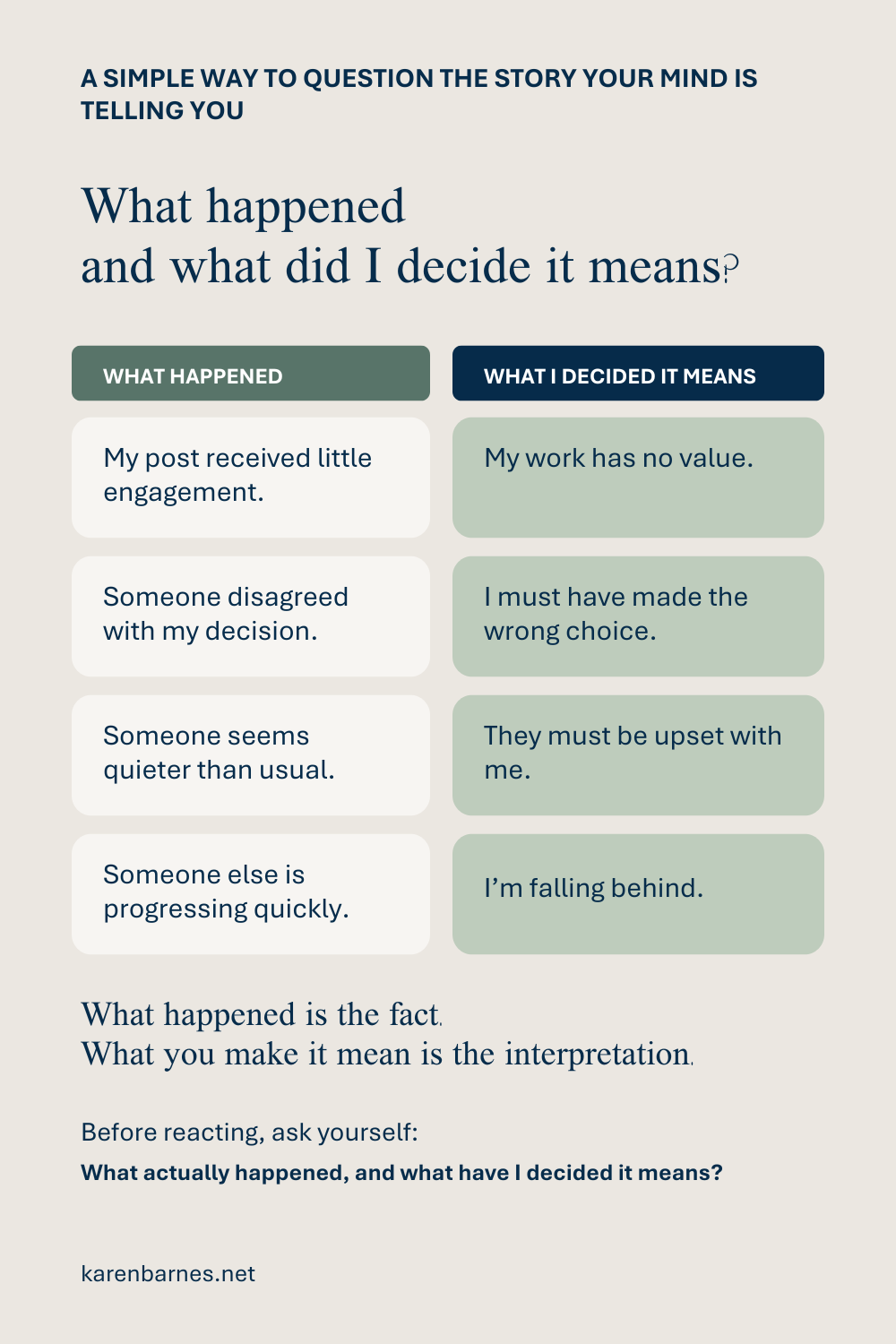
What has actually happened, and what have I decided it means?
A post receiving little engagement is a fact. Deciding that it means your work has no value is an interpretation.
Someone disagreeing with your decision is a fact. Deciding their disagreement proves you’ve made the wrong choice is an interpretation.
And that distinction matters because quite often it isn’t the event itself that pulls you away from yourself. It’s what you decide the event means.
Understand what your mind is trying to protect you from
Then get curious about what might be underneath the reaction.
What is your mind trying to prevent?
Criticism? Rejection? Uncertainty? Failure? Disappointment? That uncomfortable feeling that you’re being left behind?
Once you understand what your mind is trying to protect you from, it becomes easier to respond to what’s actually happening inside you rather than continuing to react to everything happening outside of you.
Come back to what matters to you
When you’ve spent a lot of time looking outward, it’s easy to forget to ask what actually makes sense for you.
Someone else may have an opinion about what you should do, or you may look at what other people are achieving and wonder whether you should be doing more.
But they’re not living your life. They don’t have your circumstances, priorities, responsibilities or your reasons for making the choices you do.
So bring the attention back to yourself.
What actually matters to me here?
What do I know about my own situation that someone else may not know?
Does this fit with what I want, or am I being influenced by what someone else is doing?
What feels right for me, given where I am in my life right now?
Other people can offer advice, opinions and different perspectives. Some of it may be incredibly useful. But ultimately, you’re the one who has to decide what makes sense for you.
Decide where your attention belongs
Not everything you see, hear or feel needs more of your attention.
So before giving something another twenty minutes, another hour or perhaps another afternoon of thought, ask:
Is this information important?
Is it relevant to me?
Is there something useful I can learn from it?
Does it actually require a response?
Or can I allow it to pass?
That’s really what discernment is: not shutting out the world or refusing to listen to other people, but deciding what you allow to influence you.
And perhaps that’s what real internal power looks like too.
Not having complete control over your thoughts, emotions or surroundings, but being able to come back to yourself before deciding what deserves your belief, attention and action.
The outside world will always give you information. Some of it will be useful, some of it may challenge the way you think and some of it may even change your mind.
But it cannot become the authority on who you are, how well you’re doing or what your life should look like.
Returning home to yourself doesn’t mean you stop looking outward. It means being able to look at what’s happening around you without losing connection with what’s happening within you.
You can look at what’s happening around you, learn from it, take on new ideas and allow some of those experiences to help you grow.
But before you let any of it decide something for you, come back and ask:
What does this mean for me?
The outside world may provide the reference point, but you remain the person who decides what is relevant, what is true and where your attention belongs.